
Bird Politics on the Crooked River
By Heather Day-MelgarPublished
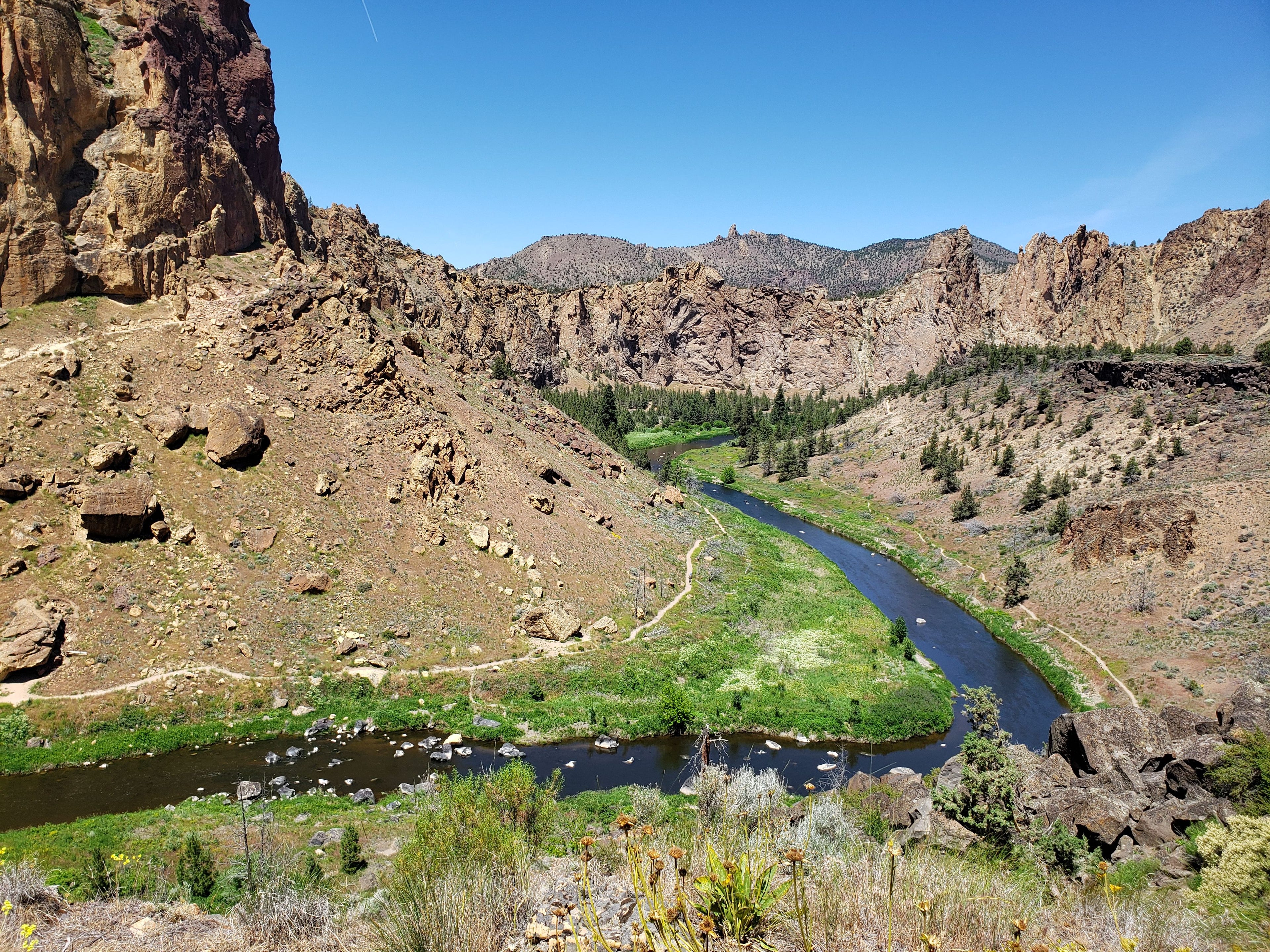
Spring in the Oregon high desert. It is a stunning landscape, east of the Cascade range. Where Douglas Fir and Red Cedar gives way to Ponderosa Pine and Juniper. You can literally smell the change in the landscape, driving southeast past Mt. Hood. In spring, the hot, dry days are already setting in. But the clear skies make for the some of the best silhouettes on the horizon.

I think many people think about the green landscape around Portland when they picture Oregon, but that really isn't the case. Half of Oregon is a high elevation, semi-arid climate. This is also the case for Washington state as well, with a similar landscape east of the Cascades. Once east of Mt. Hood, Oregon's highest peak at 11,249 ft (3,429 m), you can see the volcanic forces that shaped the land to what it now is, full of mystery and beauty to be found. A geologic and ecological playground. From the city of Bend and some of the surrounding area, one can see many Cascade peaks. Mt. Bachelor, Mt. Jefferson, Black Butte, Three Fingered Jack, Mt. Washington, the Three Sisters (North, Middle, South Sister), and Broken Top.

It doesn't matter how many times I see them while passing through, I always get excited about seeing so many mountain peaks in that close proximity to eachother. I am reminded of potent words from Buddhist teacher and writer Joan Halifax, about the power that mountains have over many of us, from an excerpt from her book The Fruitful Darkness:
Mountains have long been a geography for pilgrimage, place where people have been humbled and strengthened, they are symbols of the sacred center. Many have traveled to them in order to find the concentrated energy of Earth and to realize the strength of unimpeded space. Viewing a mountain at a distance or walking around its body we can see its shape, know its profile, survey its surrounds. The closer you come to the mountain the more it disappears, the mountain begins to lose its shape as you near it, its body begins to spread out over the landscape losing itself to itself.......Mountain then lives inside our bones, inside our heart-drum. It stands like a huge mother in the atmosphere of our minds. Mountain draws ancestors together in the form of clouds......."
Joan Halifax, The Fruitful Darkness: A Journey Through Buddhist Practice and Tribal Wisdom

It is called "high desert" due to the fact that much of it sits at 4,000 feet above sea level and higher. This desert is not sand and cacti though. This desert is colorful and full of story. It is colored by evergreens, rivers, shrubs, and wildflowers. If you want to get technical, it actually receives too much rainfall to be a real desert, but rather a "shrub-steppe," but we just call it the high desert. I have a real soft spot for the mighty Deschutes River, the second-largest watershed in Oregon, covering more than 10,000 square miles. Much of the Deschutes is located on the ancestral lands of the Confederated Tribes of Warm Springs. The river flows north 252 miles from the Cascade Mountains through the high desert, to its confluence with the Columbia river. It is beautiful, impressive, and life giving, and runs right through the city of Bend.
Another location in central Oregon high desert that I find impressive is the obsidian lava flow, Oregon's youngest major lava flow. It is located inside the caldera of the Newberry Volcano in the Deschutes National Forest, about 40 minutes south of Bend. It is such a wonder to walk amongst large chunks of obsidian, or black lava glass, leftover from an eruption about 1,300 years ago. Obsidian rock has been used by people for millennia to make tools, weapons, and jewelry. It is a beautiful piece of stone. Walking amongst the lava fields is a place where my human experience feels smaller, and rightly so. I understand that the human animal is only a small part of the story, sitting there alongside river, volcano, mountain, soil, weather, sky, and tree. I am invited in, but my ego checked. A volcanic eruption, even a small one, would take all we have built around it away, and demand new soil, new life, starting over. What a superpower. I do recommend a visit, and the walk to the flow is an easy one, only a .8 mile loop. Go be amazed by the obsidian!
From Sisters to Bend, to Prineville, to Madras, LaPine, to John Day, there is so much to explore in this area. A place I return to again and again for a hike is Smith Rock State Park. I will never forget the first time I saw it, I couldn't believe the dramatic, jagged, desert canyon landscape that almost felt out of place, tucked away in the tiny town of Terrebonne. It looked like a wild west movie set. Its jagged peaks rise up from the arid scrubby land surrounding it.

Smith Rock State Park sits at northern edge of the Crooked River caldera, at 3,200 feet elevation, just another one of the geologic wonders in the area. The caldera is a 26-mile long, 17-mile wide volcanic depression that was formed through a series of super-volcanic eruptions between 29.7 and 27.5 million years ago. According to research, about 400,000 years ago, relatively recent lava flows erupted from the Newberry Volcano, and flowed north, largely covering the caldera-filled tuff, and diverted the Crooked River up against Smith Rock, creating the dramatic rock and river landscape we see there today. The tall peaks are welded tuff rock spires, and rise 600 feet above the ground. Smith Rock is the traditional homeland of several Native American groups, including the Tenino (Warm Springs) and Northern Paiute people. Smith Rock State Park is now a popular place to visit, and draws in many rock climbers, hikers, and nature photographers.

The Crooked River flows through the center of the park, accenting the landscape, and providing habitat for many species. It is 125 miles long, and a tributary of the Deschutes River. This river was important to the Indigenous groups who called this place home before European settlement, and I always think of that as I walk quietly, doing my best to honor the history, and be a good steward of land that I love. I have visited this part of the river many times now. It is quiet and serene as it weaves and winds its way through, and there are always ducks on the water.

On a hike with my partner and 2 Jack Russell Terriers through the park in spring of 2026, there was a lot of action on the river. We heard a lot of squawking and alerting, and sat for a while to watch. There were geese with babies and ducks with babies, clearly setting some boundaries with eachother. It seemed as though the parents were giving the little fuzzy ones some swimming lessons, having them follow behind. There were 2 adult ducks with a line of ducklings, and 3 adult geese with.....geeselings? Off to the right of this cute scene were 2 stoic geese who seemed to be keeping watch, standing on a large rock rising up our of the river. It was clear that the geese and ducks had worked out an agreement as to what part of the river belonged to who, and it was clearly a respected boundary.
We watched the babies practice their swimming quietly. Then, a dark shadow came from above, and our stoic soldier geese on the rock made a ruckus, the shadow passing over them, and a great blue heron swooped in, and made itself at home on the edge of the scene on a very small rock jutting up out of the river. This dude had clearly not been invited to the river swimming lessons. There was so much noise, especially from the geese. Our stoic geese panicked when the shadow passed over, and to be honest, I did a little myself. I didn't know what creature would be joining, or if it wanted some of the babies for a meal. They did not hold back from telling heron off. But, heron was confident and cool, and barely even looked at any of the complaining. They just stood there, doing cool heron things, unbothered, and uninterested in the established river politics.

I found myself a bit unhappy that this intruding heron had nothing to say, no offering, no acknowledgement that they had scared the geese, and interrupted baby swimming lessons. And then I found amusement in my investment of the scene. Maybe I just did not understand the way these birds negotiate and communicate. Maybe heron was embarassed, or, maybe, they had been invited and were unfashionably late, as per usual. Maybe they had forgotten the snacks they had offered to bring.

As I get older, I get wiser. I continue to pull away from things, places, and situations that that do not feed my creativity, peace, or soul. I would much rather watch the bird politics on the Crooked River in the Oregon high desert than do most things. So, here is your invitation, or maybe your assignment. Go to Smith Rock State Park, and hike the River Trail. Find a sit spot with a clear view of the river, and just be there. Watch, listen. Maybe, just maybe, you will get to see what the geese think of the heron.

A love letter to the Oregon high desert:
The smell of warm ponderosa, juniper, and sagebrush on a sunny day has always been medicine to me
The way the red dirt glitters in the sun
The way heat stills everything, forced into a quiet submission to the force of life
We sat in a bowl, mountain peaks marking the edges
Jagged, still white with snow
10 of them, volcanic behemoths
Black obsidian lava flows
I am so glad to know you all
To know your different angles and faces
My favorite silhouettes
Walking amongst giants
Clear cold glacial rivers
Have washed my worries away
I will always come back
Back to the quail, the red wing blackbird, the lizards, the heron, the snake
The goose that upholds the river politics
I will always wander back to you
Comments
No comments yet. Be the first!